
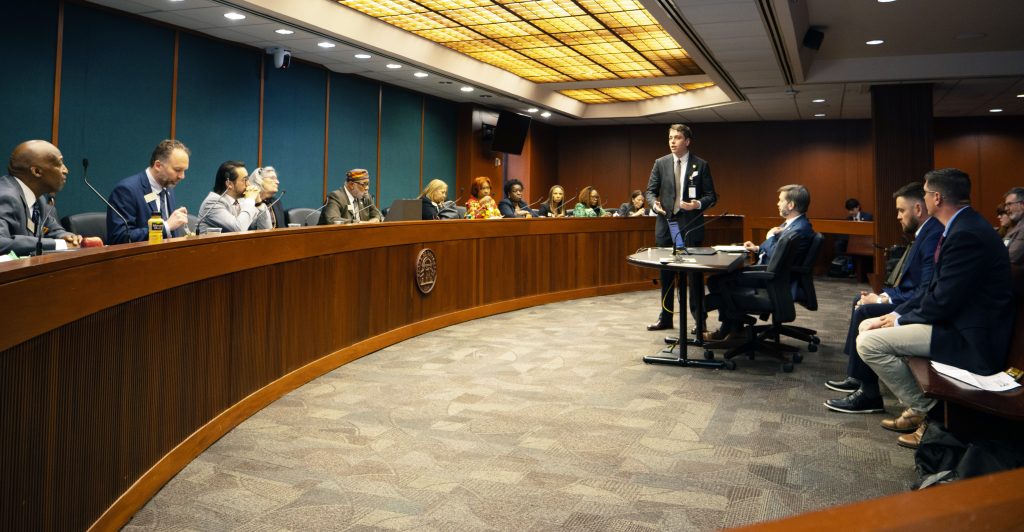
SRCC staff educated Georgia legislators on construction industry tax fraud during the Working Families Caucus luncheon held in Atlanta Feb. 26. The SRCC had the opportunity to talk with policymakers about an ongoing problem that has allowed companies to misclassify workers as independent contractors, pay them under the table to minimize costs, and win contracts by underbidding.
This leads to less work for union contractors and their employees.
The Working Families Caucus is a group of state representatives and senators who are allies for organized labor, prioritizing issues that impact working families in Georgia. SRCC representatives spoke about the prevalence of tax fraud and worker misclassification in the construction industry, which leads to loss of tax revenue for states, and a lack of benefits for workers, who are forced to apply for government safety-net programs, effectively shifting the burden from companies to taxpayers.
Julian McDaniel, government affairs representative for the SRCC, outlined how widespread worker misclassification, payroll fraud, and the use of “ghost” workers’ compensation policies allow shady contractors to underbid honest, law-abiding employers.
“A minimum of one in five contractors commit federal tax fraud,” said McDaniel. “They do it to steal jobs from taxpaying, law-abiding contractors, such as those who are signatory to some of our collective bargaining agreements.”
Although Georgia passed a worker misclassification bill (House Bill 389) in 2022, the lack of enforcement has allowed contractors to change their tactics and continue abusing the system.
According to a report by the UC Berkeley Labor Center, Georgia might have 42,000 to 80,000 misclassified construction workers, resulting in more than $284 million in taxpayer losses and more than $570 million in evaded costs annually. Nationally, in the construction industry, tax fraud is a $10 billion problem that steals taxpayer funds that could be used for schools, infrastructure, and housing programs.
Tax fraud in construction often overlaps with wage theft and workers’ compensation insurance fraud, in which some contractors hide payroll evidence, falsely claiming they employ no workers. When injuries occur, labor brokers may even discourage workers from identifying their employer, pushing medical costs onto hospitals and the public rather than the responsible contractor.
To combat this growing issue, the SRCC government affairs team has been working on a bill in Tennessee modeled after recent reforms in Minnesota.
The proposed “Zero Estimated Exposure Policy Act” would require contractors claiming to have no employees to formally attest to that status. “It’s intended to help address the problem of construction services providers fraudulently obtaining ghost policies for workers’ comp insurance,” said Jackson Wright, policy coordinator for the SRCC.
If passed, the Tennessee bill would provide enforcement agencies with crucial evidence to pursue fraud cases. While similar legislation was not introduced in Georgia this session, the SRCC government affairs team hopes Georgia and the Carolinas will eventually adopt similar safeguards once Tennessee’s results are better understood.
Caucus leaders reaffirmed their pledge to ensure Georgia’s Department of Labor enforces existing misclassification laws and protects workers and ethical contractors alike.